Tuesday, July 30, 2013

The Comfort and Company of Strangers

 NPR host Scott Simon shared his mother's final days with the world. (Politico)

Three years ago, actually three years ago to this day, I walked out of the church of my childhood and thought, “I never have to go through this again.”

I didn’t mean Mass, although I’ve managed to avoid that since then. I was walking out of the church after my mother’s funeral and thought, “Both of my parents are gone. I never have to go through this grief again.”

It was a strange feeling of relief and it brought me a little momentary comfort. The problem was it turned out not to be true.

I used to feel a sense of relief about it. Now I just hurt for what awaits my friends and cousins.

Mother asks, "Will this go on forever?" She means pain, dread. "No." She says, "But we'll go on forever. You & me." Yes.

I thought of that experience while I read the touching tweets from National Public Radio host Scott Simon as he told the world the details from his mother’s deathbed in the past few days. He was, essentially, live tweeting the end of his mother's life the way one might live tweet a basketball game or the Oscars. On the one hand it seems odd and creepy. But if you have gone through this, you know you have so many thoughts to sort through when, ironically, life comes at you fast and furious as a life around you ends.

Simon seemingly has had to go through much of this alone. I can’t even imagine. There are six of us. And there are children. And there are spouses. And we were there.

My mother’s end came quickly. A slow road to quickly, but what was expected to be a temporary stay in a nursing home became the last place she slept. We promised her we’d never leave her alone and we never did, and none of us were ever alone with her for her final three days.

And if you think they don’t know what is going on around them, you are seriously mistaken.

I know end might be near as this is only day of my adulthood I've seen my mother and she hasn't asked, "Why that shirt?"

My mom was in and out of consciousness the last two days of her life. As she slept, I had a conversation with one of my sisters about something someone close to me had done that I thought was particularly appalling. It was something recent and raw and something I had kept from my mom because I didn’t want her to feel bad for me.

It didn’t matter. You apparently can’t keep a mom from protecting her children even when she is unconscious. Later that day I heard her mutter in her sleep the name of the person who I had told my sister about, saying over and over again, “X isn’t good to Jane. X isn’t good to Jane.”

I tried to protect her from feeling bad one last time. I failed miserably.

I am getting a life's lesson about grace from my mother in the ICU. We never stop learning from our mothers, do we?

Yet the company in the room clearly made a difference for her, even when we thought it might not.

“It’s too quiet,” my mom said in a moment of lucidity two days before she died. My siblings and I enjoy each other’s company immensely. It was clear it was OK to have a good time in Mom’s room if we wanted to. In fact, it seemed to be her preference.

That’s good, because in a weird way, we did. Little by little the whole family rolled in and my mom woke up clear as day and saw her grandchildren, two of which came from across the country. The joy on her face will stay with me forever.

We gathered up enough chairs to have a dozen or more in a horseshoe around my mother’s bed. At 1 in the morning we sat and dished and chatted and giggled, even as Mom lay unconscious. I had left my bottle of water on the opposite end of the horseshoe and asked my brother to pass it to me. Like a beer purchase at a baseball game, the bottle of water went one by one through a row made up of my entire family.

Like at a baseball game, I gave my brother a dollar and passed it back one by one among my family. My brother took the dollar, pulled out four quarters and passed them back to me.

Oh, to have gone through this alone, I cannot imagine.

I am not sure my mother understands Twitter or why I tell her millions of people love her--but she says she's ver touched.

Via social media, Scott Simon captured the beauty and the pain wrapped together in one of the hardest moments life can give us. He found some company, too, in the more than a million people who are following him. It wasn’t exploitative, it was painfully real.

And it didn’t have a happy ending. His mother died Monday night.

The heavens over Chicago have opened and Patricia Lyons Simon Newman has stepped onstage.

She will make the face of heaven shine so fine that all the world will be in love with night.

I wasn’t there when my mom passed. I feel awful about that, but I couldn’t have known it would be at that moment. It’s not like TV or the movies when someone just benevolently tells you, “It’s time,” and everyone gathers like the Whos down in Whoville.

This is what looms for so many that I know. I wish I could say it’s easy, but that would be a lie. I wish I could say you can prepare, but you can’t. I wish I could say you'll do everything right, but you won't. What I can say is there can be instances of incredible beauty that will stay with you longer than the pain of the moment.

Scott Simon showed 1,244,957 of his followers that over the course of a few days. Clearly, they showed it right back to him.

Thank you for all yr warm wishes and prayers. Such love drives the world.
------------------------------------------------------------------------------------------------------------------------

Scott Simon can be found on Twitter at twitter.com/nprscottsimon

Tuesday, June 25, 2013

Some Jokes Can't Be Covered in Butter and Sugar


Paula Deen says she can't determine what people might find offensive. (WireImage photo)

It’s supremely perfect that in the English language, “sorry” is meant as an apology and to describe something that is quite pathetic. Because sometimes, apologies are the sorriest things of all.

The latest on the sorry front is Paula Deen, whose name alone can spark arteries to harden. The queen of decadent cooking, the big-haired personification of American indulgence, not only used racist language but made herself look worse by trying to explain it.

Sure, her logic went, she used the N-word. But she used it as a joke, she said in a deposition relating to a discrimination lawsuit filed by a former employee. She also said in the deposition that she taught her children not to use that word in a mean way, as if there magically were some nice ways to use it.

This isn’t yet another piece to hang the Countess of Cholesterol out to dry. She’s just the latest in a long line of people who have this odd notion that if they take some of the rudest, most offensive notions in our culture and make a joke out them, suddenly they magically aren’t offensive anymore.

“I can't, myself, determine what offends another person,” Deen said in the deposition, echoing the same sorry words of so many before her.

In this day and age, how is that possible? I know it happens all the time, but how does one get through life without grasping that using horrible language might just possibly offend someone? Deen’s behavior doesn’t show racism as much as it shows a willful oblivion, an arrogance to never stray from your way of thinking, to never ever see beyond your small butter-slathered world.

I’m a little touchy about the Paula Deen situation. It has nothing to do with the fall of a food icon and everything to do with bringing to the fore the thing that I am ashamed of most in my life – thinking racial things were funny.

Admittedly, this is when I was in high school and not exactly an intellectual. But I was brought up in a very kind and loving household where not only was the N-word banned, so was the use of “redskin.” In grade school, there were no black kids at my school but there were Native American kids and I heard both those words thrown at them as early as the first grade. And I knew it was wrong.

I grew up in a very white area that while not being notably racist, it didn’t keep me from hearing the N-word over the years. I even remember hearing a grown-up I knew and loved talk about the election of Tom Bradley as mayor of Los Angeles, saying that although he wouldn’t want an N-word as his mayor, it’s probably good that a place that had so many of them had one of their own kind to lead them.

Taught to respect my elders, I said nothing, but I was a grade-schooler who knew that was wrong and I still remember what my whole body felt like to hear that. The horror remains to this day.

By the time I got to high school, there were a few black kids at my school. One was in my class and had a couple younger siblings, another was an exchange student from Kenya. I haven’t seen my classmate since high school, but I think of her often. This is a kid who was brave enough in gym class circa 1976 to announce, “I know everybody wants to touch my hair, so you get one chance. Today. If you want to, you can, and don’t ever ask again.”

One of the interesting parts about moving back to my hometown is reconciling my memories of what I thought was reality with the grown-up view of what likely is the truth. I didn’t think much of what life must have been like for my classmate then, but I’d sure like to ask her about it now.

And high school is where my tale of shame begins. It really begins with “Roots,” which was supposed to open our eyes about race in the first place. With me, what started as a smart-aleck remark turned into a way-too-long joke.

With “Roots” being television that gripped the nation, it was what we talked about in school, too. I spun a tale to a classmate that I enjoyed watching this with my family because it was our story, too. I said that I had black relatives on my mom’s side of the family (her maiden name was “Schwarz,” German for “black.”) and it spun from there. He realized my hair was curly – it was a perm – and suddenly believed the story. My friends and I never thought to correct him, and the fact that my favorite foods in the world were, and remain, fried chicken and watermelon only added to the hilarity we saw in this.

And from there it continued to build. There was a nickname of “Kizzy” and gifts of toys like Mammy dolls. Once we began to notice that these toys and products existed we were rather shocked – perhaps foreshadowing the less-dunderheaded adults we would become.

These were jokes but we weren’t racist, we thought. It was just in fun. No big deal.

Then I went to college. Nothing dramatic happened in that anyone discovered this and smacked me down for it; by then it was a joke that had long ended but one in which I still saw no harm. Then, in an indirect way I found myself on the receiving end of the same kind of “joke.”

I had a guy friend, a sweet guy, one with many women friends. He told me how hilarious it was in their dorm that he and some of his friends would go up to the women’s floor and “pretend” that they were boors – chauvinistic and abusive. He said how funny it was that they’d pretend they were going to attack the women and the guys even had a little name for their gang, the make-believe group of guys who thought scaring women and pretending to do them harm was nothing more than a joke.

This guy was my friend, and I know he’d never be part of truly carrying any of that out. But it hit me like an anvil on my head: It wasn’t funny. It didn’t matter if they didn’t really mean it, it wasn’t funny and in fact was rather horrifying. All these years later he is a loving husband and father to a daughter; I suspect he no longer thinks it was funny.

At that moment, I realized our little racist jokes weren’t funny either. To take a part of one person’s identity, something they value such as their race, gender or ethnicity, and turn it into a punch line is the very definition of cruel.

And that’s where I have an issue with Paula Deen and situations like hers. Somewhere along the line in life, how can you not learn something to put you in someone else’s shoes, if only for an instant? As ashamed as I remain about those jokes, I also know that light-bulb moment created the empathic adult I am today. I could never tell this tale and no one would be the wiser and my friends might like me more, but it seems important to me that people realize it’s not just “those people” who make these kinds of mistakes. It’s what happens after that counts.

Sometimes, that includes bad apologies. I’m sorry, I have trouble with apologies that include the word “never meant.” People who miss stop signs and kill people they crash into never meant to do that, yet there are pretty clear and obvious rules that someone shouldn’t do that. Paying attention to other people and their lives shouldn’t be that much different than navigating the signs and symbols that make up our everyday lives, but somehow people always seem to get a pass on that.

And that is as sorry as it gets.


Tuesday, May 21, 2013

Extra! Extra! Newsrooms For Sale!

Want to buy a newsroom? There's one for sale in Des Moines.

Somewhere, on the third floor of a building in downtown Des Moines, behind a security door and under relatively recent drywall or paint, there is graffiti that may stay there hidden forever.

“For a good time, call Jane. 8128.”

The wall may remain, but the reasons for the graffiti are long gone. It was put there by composing room guys, the newspaper equivalent of passenger pigeons – extinct. In a different time and a different place, the 1980s, the composing room staff pasted the articles onto a board as part of the plate-making process. With X-Acto knives in hand, they trimmed the stories at editors’ suggestion, human versions of Control X. What started out as just a phone number (mine) on a wall so they could get ahold of me one floor up in the sports department evolved into a bit of fun that I never minded even as a 20-something, since some of these old-timey guys I looked at like an uncle or grandpa.

These days, it’s not just the composing rooms that are becoming extinct. It’s the newsrooms altogether. Technology has changed what newspapers need – the printing presses can be off site, the staffs have shrunk, reporters can work from home or a coffee shop, photo staffs don’t need darkrooms anymore. Because of that – and the fact that many of them are in prime downtown real estate areas of their cities --  the classic newsrooms are going away.

The newspaper I worked at for 18 years, the Des Moines Register, has its building up for sale and will be moving down the street. The paper I worked for after that, the Minneapolis Star Tribune, has a building that sits right in the midst of downtown development around a new Minnesota Vikings football stadium and a move looms. The Washington Post building, where Woodward and Bernstein wrote stories that took down a president, is for sale.

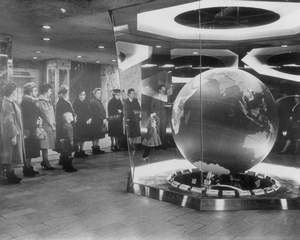
The Register globe in the 1950s.

There’s much romanticizing of these places, and it’s not unfounded. My description of the Des Moines Register building always has been that it looks like the kind of place where Clark Kent and Lois Lane would work.There are beautiful marble staircases, with steps worn down from a century of journalists running up and down them. There is a giant globe in the lobby. Plaques of Pulitzer Prize winners (there have been 16 of them) greet visitors. Historic pages, with great headlines like “Earthquake Leaves San Francisco A Charnel House” line the hallway to get to the newsroom. Until 2000, the presses were in the building’s basement, with tall open windows from the street that allowed passersby to watch papers being printed.

It’s easy for those of us who don’t work there anymore to express shock and horror at the thought the newsroom is moving and changing. The newsroom in our minds was a city block long, with cigarette burns in the linoleum and the lingering echoes of barking editors. The reality is of a worn-down place that will never get the overhaul it needs.

Sometimes buildings wear out. Sometimes they aren’t so useful anymore. It’s sad, and I am all about preservation, but some things weren’t built to last or at the very least, they need a lot of tending.

The newsroom of my mind is a wonderful place, with a tough, crotchety editor who dreamed of one day getting to write a headline that said “Santa Found Dead In Alley.” Sadly for him, but happily for Santa, that
The newsroom of the 1980-90s.
never happened in Des Moines. It’s a place that the huge west-facing windows used to offer a free and clear view of the sunset every night and for the gorgeous ones, we’d stop what we were doing and watch. It’s a place where those same composing room guys would fill a pneumatic tube with popcorn and mark it “For Jane” and shoot it upstairs to me on a Saturday night.

But the newsroom of the real world is a place where blinds now block those windows so people can actually see their computer screens. In some ways, it's no loss; the flurry of downtown development in the past 15 years has taken away that western sunset view.

A hollow room once filled with presses.
The building and its newsroom are a place that has been retrofitted so many times for the continuous change of the industry that it’s recognizable but not familiar. It’s a place where the bathrooms are falling apart and the first newsroom staffers who show up to work post the temperature on Facebook so their co-workers will
know how to dress that day. They’ll either freeze or they’ll sweat, and indeed, on an afternoon visit there last month I went from being comfortable to wishing I had worn layers. Many of us who worked there wonder if health problems we've had were related to toxic presses in the basement.

For the people who are there and have to endure the romantic, not-based-in-reality notions of the staffers of the past, I understand how they might be tired of hearing that. I understand it every time I drive down the main street of my town, past the empty lot where my family’s home used to be.

The house has been gone for seven years now, but I still hear sadness from people on a regular basis. “Oh, it just breaks my heart every time I drive by where your house used to be,” they say.

For me, not so much. Our house, while a place filled with memories, had reached its time. Like the newsroom I love, it had been built onto and retrofitted so many times it could not take so much as another nail. An old building that had once been a Sinclair gas station circa 1932, then a pet hospital and then a photo studio with a house for eight people on top had nothing more it could give the world. With its flat leaky roof and many other issues, I think my mom would happily have swung a ceremonial sledgehammer before the bulldozers began their work if one were offered. I know I would have.

“It must be so sad not to see your house every time you drive by,” is something I hear a lot, too.

And nothing could be further from the truth. I see my house in my mind all the time. I see my sisters and me in Dad’s photo studio playing with his old Mathew Brady-like camera. I see my aunts and uncles and cousins shoved into all the rooms at card tables having Sunday dinner. I see my brothers learning to walk. I see my mom at the supper table, putting down her utensils after finishing a meal and saying, “Damn, I’m a good cook.”

The newspaper buildings will be gone, too, but not really. If anyone can tell stories, it’s newspaper people. And they’ll tell the stories of these places so well that if you close your eyes you’ll be able to see anything you ever wanted to see.

Except, perhaps, Santa Claus dead in an alley in Des Moines. And that’s probably a good thing. 

And if a bigger East Coast paper is more your preference, the Washington Post is also available.


All black-and-white Register photos used by permission and are part of an online history of the building, Tradition on the Move.

Press room photo by Andrea Melendez

A before-and-after look at Minneapolis development done by the Minneapolis Star Tribune shows green space where the Star Tribune newsroom now sits.

Wednesday, May 8, 2013

A Mom Is Always a Mom


No matter how old you are, sometimes you still want your mom to come to the rescue.

About this time last year, I came up with what I thought was an extraordinary realization.

I knew my mother when she was the age I am now.

This, I surmised, would provide me with insight into the whole complex mother-daughter relationship thing.

It was a revelation that lasted but a few months. Soon I found that all the insight in the world did not matter. We are mother and daughter. Always have been. Always will be.

***

My mother, the nurse, knew that I was ill. Something wasn’t working right; she saw it in my walk.

Get to a doctor, she said, and I agreed. I just wanted to make the 275-mile journey from Mt. Horeb,Wis., back to Des Moines.

Yet the hardest call to make the next day, when it was apparent something was very wrong, was the call to my parents. What made it harder was that nobody was home and this was the kind of thing you really can’t leave on an answering machine at 10 p.m.

Mom, it’s me. I’m in the hospital, but don’t worry. I’ll call you back later after my spinal tap.

Right.

You don’t want anybody to worry, that’s why it’s such a hard call to make. You don’t want to utter those words, “Mom, come help me” because it seems as if you’ve lost control. To be 35 years old means you’re not supposed to be calling Mommy for help.

“Do you want me to come down?” my mother asked when I finally reached her.

“It’s not so bad. I just have to have a lot of tests,” I said.

“Do you want me to come down?” she repeated.

My boyfriend was here, so were my friends, I said.

“Do you want me to come down?” she asked again. She could be there by the next day.

Yes, I said. Please.
              
***

My health has always been a strange bond between my mother and me. In a family full of six children, me in the middle duo, it was about the only way to get the rare one-on-one with Mom.

There were the leg braces as a small child and the shopping trips to get corrective shoes. There was the back brace as an adolescent, which meant trips to Milwaukee for a specialist and years of doctor appointments. Those meant time off from school, afternoons at the mall, lunch in a nice restaurant or hot fudge sundaes at the ice cream parlor.

I got afternoons with my mother that my brothers and sisters never did. It didn’t make us any closer than she was with them, but I knew I was getting privileged time.

When she was on her way to Des Moines, I knew I had made the correct choice. Overnight, my health had worsened. I had been diagnosed with Guillain-Barre Syndrome, a potentially crippling neurological disorder. The previous day, I was able to walk into the doctor’s office. Now, 24 hours later, I could barely walk at all.

Guillain-Barre is a weird thing. Who it attacks and what it attacks are random. Out-of-control antibodies attack the coating on the nerve endings instead of a virus that is already in your system, something as minor as a flu bug.

The effect is, essentially, the short-circuiting of the central nervous system. Any nerve or muscle in your body is a target, from the ability to blink to the ability to breathe. Which ones are hit is merely luck of the draw. Although the prognosis is generally optimistic, what abilities patients may recover and when are equally a mystery.

My mom knew of the diagnosis from my phone call --my doctors had  figured as much when they saw me walk into the office. Ironically, that day at work, a co-worker of my mom’s had returned a pamphlet on Guillain-Barre that she had borrowed from my mother’s files. It had just been there at the hospital for future reference. My mother needed it sooner than she thought.

*** 

I don’t remember much of the first weeks I was ill. I just know my mother was there. She slept in the bed beside me and did everything a sick person would need, everything you use a call button for to summon a nurse.

She walked me to the bathroom, clinging to me as I shuffled along in baby steps. She opened the food containers that my bumbling hands couldn’t manage and filled out menus for the next day’s meals because I could not write. She quietly ducked out of my room to give me privacy when my boyfriend or friends came by or it was time for my doctor to ask me personal questions.

She watered my flowers and complained on the rare days we didn’t get any. Yes, we. “Aw, nobody sent us flowers today,” my mom would joke.

She watched my health slip and was there when I was at my worst. My friends were supportive and my boyfriend was a rock, yet it was my mother who was the glue. She was the one who saw me at my worst. She saw things none of the rest did.

She was there when we couldn’t make the trip to the bathroom anymore and she had to lift me off the bed onto the commode. This is a woman of 64; I am nearly 6 feet tall. Her strength still amazes me.

Yet, there was always the mother-daughter thing underneath all of this. In addition to the Guillain-Barre, my doctors were searching for the virus that triggered it. My liver was not functioning properly, so there was a barrage of tests. One particular type of hepatitis test came back positive.

Whatever, I thought, more pills.

"What have you been doing?" my mother inquired.

Turns out this form of hepatitis can be sexually transmitted. My mom the nurse knew this; I didn’t. The scowl of disapproval from her is one I’ll never forget, even after someone came in 10 minutes later to say she read the test wrong and I didn’t actually have that ailment.

That didn’t matter; the damage was done.

This is how overwhelming the mother-daughter bond can be: I have lost my ability to walk, I’m struggling to breathe, I cannot eat, I cannot sleep, I drool way too much, I have excruciating back pain, I have tubes running in and out of me, I’ve lost the use of my hands and am soon to lose my ability to speak. But my biggest worry is that my mother thinks I’m a tramp.

*** 


Because my mother saw me in much worse shape than anyone else, I’m grateful she’s the one who was there when things began to turn around. One day, I took a nap and when I awoke I realized I was sick of my room. Except for, literally, lame attempts at walking down the hall, I really hadn’t been outside of it in two weeks.

Yet all of a sudden there was a wheelchair in my room and I wanted to get out. It was as if I were a small child asking a parent if I could see where they worked. I could get a sense of the happiness my mom got just from giving me a tour of the hospital. I wanted to get out of bed and sit in a chair; this was also a breakthrough that my mom was more than happy to accommodate. Little things, but big things.

She went to Wal-Mart to buy me the sweat pants I would need for my move to the rehab unit. Together we made the move upstairs and saw my new room.

It was a room in which she wouldn’t be sleeping; she went to my house instead.

Who will I call to take me to the bathroom? I asked. That’s what they pay the nurses for, Mom said. What if I need something in the middle of the night? I asked. Use your call button, Mom said.

At age 35, I was terrified at the thought of my mother not being there. And after the first day of physical and occupational therapies, she knew my days were full without her and it was time for her to go back home to Wisconsin.

I could have been a child left at the kindergarten door. I could have been a Girl Scout on my way to camp. I could have been a college student dropped off at the dormitory. I may as well have been for the way it hit me that I was on my own, without my mother.

The whole point of rehabilitation is to teach you independence. They just never specify from what.

*** 

A month later, I was out of the hospital and walking with a cane. My mom returned to spend a week with me, and it’s a trip I still kind of feel guilty about six months later.

I wasn’t the toddler who needed my mother anymore. I was a teenager hell-bent on proving my independence.

She arrived just at the time it was becoming conceivable that I would recover and be able to take care of myself. A pity she had to go through that with me twice in one lifetime.

Somewhat surly, I didn’t really say much at home. That had nothing to do with her; in six weeks in the hospital I had made a lifetime’s worth of small talk and I just felt like keeping to myself.

"You know you could say good morning to me," she said once.

"Sorry," I replied.

She left one day to go to the casino. I took my car and drove around the neighborhood. Days before, I had discovered that my hands and feet worked well enough to drive and I just wanted to get out of the house alone.

Like a teenager, I sneaked out of the house with the car when my mom wasn’t home. Only it was my house that I own and my car that I own. It was too weird.

The difference in age is this, however. I realized my rudeness in about a weekend. When you actually are a teenager, it takes about a decade.

***

So, yes, I knew my mother when she was the age I am now. Big whoop. At that point, my mom had four of her six children, had been married a while and as a nurse and paramedic had seen things I’ll never see in my lifetime.

And I’ve trouped through my adulthood as a single woman with choices and opportunities my mother either never had or never considered.

But a few years before my mother was this age, she gave birth to a daughter who would grow up to need her just as much at 35 as she did at 5. She is my mother and I am her daughter, regardless of age.

That has never changed. It never will. I know that now more than ever.

(This post first appeared as an article in the Des Moines Register in May 1997.)

Monday, April 29, 2013

Out There, For All the World to Know


Yes, it’s a big deal.

A few hours into the news cycle of Jason Collins’announcement that he is gay, perhaps the most perplexing comments of all seemed to be that this is not news.

I know, I know, reading online comments only brings horror and exasperation, but I was more or less just curious what direction they were taking in the sports world. And I was more or less surprised not to be appalled.

Of course there’s the snark that comes when a journeyman player most have never heard of comes out. Things like “Jason Collins is a gay NBA player? I didn’t know he was still in the NBA.” The jokes seem to be mostly about who Jason Collins is (or isn’t) as a ballplayer than anything else that I’ve seen.

And that’s a good thing.

There are also the comments about this not being so Earth-shattering if it had been a superstar, but Jason Collins himself summed it up by saying someone had to be first and it might as well be him.  Of course it would have been an even bigger deal if it were Kobe Bryant or Kevin Durant, or a superstar in the NFL or Major League Baseball.

And that’s true, but it doesn’t take away the impact of it all.

It’s those who wonder why this is a story at all that make me scratch my head the most. The online commenters have been joined by sports talk radio hosts on that non-topic topic as well. It might not be a big story to you, but guess what? This isn’t about you.

To say this isn’t a big deal, that his sexuality being known is not important, is to assume that Jason Collins is going to be warmly accepted with open arms by every person who hears the news. The same way gay kids are so warmly accepted by everyone they encounter in childhood and beyond. The way some gay employees don’t want to come out at work because they don’t know how they will be received. The way many gay people don’t want to come out to their own families for fear of being disowned or condemned as a sinner.

To say Jason Collins’ announcement isn’t news is a slap in the face to everyone who has been on the receiving end of pain and prejudice throughout their lives. To simply say it’s the media latching on to a good story sells the media short, too. In its most noble form, what the media has always been is a way for people to tell their story. Every newspaper in America fields calls every day from people who feel they have been wronged and want the paper to help. Jason Collins had a story to tell, and found a respectable outlet in Sports Illustrated to convey it where it would have the most impact.

Jason Collins can be told his inside game sucks, or that he never really amounted to much in the NBA.

Just don’t tell him or anyone else that what he did by coming out is insignificant. One day it might be insignificant when a U.S. male pro athlete comes out as being gay. And if that day ever occurs, he'll be able to give a big thanks to Jason Collins.

Friday, April 12, 2013

Sometimes, the Game-Changer Is an Actual Game


Jackie Robinson changed everything when he broke baseball's color line.

It might have been a fair point the guy raised when he wondered about my profession if he himself hadn’t been so utterly lacking in perspective.

It was years ago, when someone asked me what I did for a living and I replied that I was a sportswriter.

“That must be tough,” he said. And before I could answer he continued, “I mean every day you go somewhere and someone wins and someone loses and you tell the same story over and over. It must be tough to stay interested.”

I was dumbfounded because this comment came from a singer-songwriter (admittedly one I never did like) who, conceivably, made a living by singing the same songs over and over.

Such is the life of the sportswriter, putting up with many people’s perceived notions of sports. You’ve heard them all: a waste of time, opiate for the masses, rich men’s game, etc. etc.

Here’s one few bother to mention: Effective tool for social change.

As “42,” the biopic of Jackie Robinson, heads to theaters this weekend, it’s chance again to celebrate the bravery of the man who broke baseball’s color line. Many other upheavals in racial relations followed in the years to come, but it’s hard to imagine any of them happening if change hadn’t first come to baseball.

Yes, sports are fun and games sometimes but they have also been a key factor in civil rights and gender equality in this country. No doubt sports writers in 1947 and beyond realized they were watching much more than baseball; they had to know they were watching history.

And it was a sports writer who had started to beat the drum of equality in baseball a decade before. A man named Lester Rodney is sadly a footnote to history, most likely because he worked at a Communist
Lester Rodney (Ray Rodney photo)
newspaper. But in his columns for the Daily Worker that began in 1936, Rodney championed Negro Leagues ballplayers, took on the powers that be in Major League Baseball by calling for integration and very early on took note of a talented young man named Jackie Robinson before any newspaper written for white folks ever did.

“You go back and you read the great newspapers in the ’30s, you’ll find no editorials saying, ‘What’s going on here? This is America, land of the free and people with the wrong pigmentation of skin can’t play baseball?’ Nothing like that,” Rodney told writer Dave Zirin in 2004, five years before Rodney died at age 98. “No challenges to the league, to the commissioner, to league presidents, no interviewing the managers, no talking about Satchel Paige and Josh Gibson who were obviously of superstar caliber.”

A victory off the court, too. (AP)
A similar change came 26 years later when Billie Jean King’s victory meant everything to the women’s movement. It’s hard to wrap one’s head around that now, that a made-for-TV athletic event of a women’s
tennis player at the peak of her career defeating a 50-something former pro men’s player would do in some way for women what Jackie Robinson did for African-Americans. After that people paid attention to women and girls as athletes and the stage was set for implementing Title IX and much that came after.

I have a friend, a feminist who often writes on women’s issues. About 20 years ago, when I was covering women’s athletics, she admitted she knew nothing about sports and didn’t know what Title IX was.

“I’ll teach you,” I said, “because calling yourself a feminist and knowing nothing about sports is like calling yourself a Civil War scholar and knowing nothing about Abraham Lincoln.”

I was in a polyester uniform when sports for girls and women began to change in the 1970s, and courtside as they transformed in the 1980s and 1990s, as were many of my friends. Indeed I enjoyed covering women’s basketball because I had played it and enjoyed the sport, but there was something greater at work. I wasn’t just sitting courtside at basketball games; I had a close-up seat to history.

For many sportswriters who covered this stuff, that was a motivation to do it and to do it well, male or female writers. It wasn’t just the fun and games of it all – though it really was a fun way to make a living – but there was a greater good to it all sometimes. I understand why other women my age might have wanted to cover the NBA or NFL, but I did not. It was too exciting to be part of something that was growing, changing and creating opportunities where once none had been. I’m a history geek and I knew I was seeing it live.

I’m not saying sports writers deserve the credit for the social change that transpired under their watch. The bravery was all on the part of the participants, and I can only wonder what it would have been like for a Jackie Robinson or Billie Jean King in our toxic anonymous media-saturated culture. I wonder if they would have survived with their lives, Robinson in particular.

Now we're at a point where baseball worries about not having enough African-American ballplayers and girls walk around tall and proud in their letter jackets and sweatpants; that says everything about how sports has made a difference in who we are as a nation.

Anyone who thinks differently is just singing the wrong tune.


Friday, April 5, 2013

Everyone's a Critic, But There Was Only One Ebert


Roger Ebert was famous for a thumb's up or a thumb's down, but it was in reading what he wrote that movie-goers could learn about the films they love or hate. (Reuters photo)

If I really wanted to push a Brush With Greatness, I can truthfully say that I was once replaced by Roger Ebert.

Not that he noticed. Or even knew where he was ending up. Or that his life was made any the richer for now being on the pages of the Des Moines Register.

Such are the weird twists and turns my life has taken over the years: When I left Iowa, I had been a film critic for the Register, and have written about movies off and on for the past 15 years. When I left that job, I was replaced with wire-service copy until the paper brought on another reviewer, then stopped having staff-produced reviews altogether.

As many papers opted for the same route, Ebert’s reviews became all the more important to people, certainly those in the Midwest. We’re not Hollywood flash or East Coast superiority; we’re regular folks who are smarter than people think and do not suffer fools.

That’s why Roger was our guy. He was a Midwestern guy who wrote about movies but also looked like a guy you might see down the block with a garden hose in hand. If you couldn’t have someone local writing about this stuff, this guy still seemed to know who you were and what you wanted out of your movies. It was only after papers began cutting back on their local reviewers and the Internet took over the world that some people finally got a chance to read Ebert instead of just watching him on TV. And for all his TV fame, in print is where he truly shined.

In some ways, he made it look easy, which had to have been a blessing and a curse. It was great that he wrote for the average movie-goer as much as the academic, but his facility at that no doubt led to a sense that everyone could do it.

And trust me, it isn’t easy. In any kind of opinion writing you risk offending people. In reviewing movies, something so basic to everyone, you risk offending things that people hold near and dear. If you don’t like something they love, it’s sometimes as if you have wounded them as a human being.

I once had a voicemail message left for me from a guy who was ticked off at me for my review of “Detroit Rock City,” a road/buddy movie about guys going to a KISS concert. I didn’t give it a very good review and this guy, a huge KISS fan, was livid. I won’t go into details about what he thought someone should do to me.

And the thing is, the reason I didn’t like it was because KISS is awesome and deserved a better film than that. I wasn’t reviewing KISS, I was reviewing a film about KISS, yet this guy couldn’t see the difference.

I also gave either a one- or no-star review to an alleged film called “Three Strikes.” It was written and directed by rapper DJ Pooh and co-starred the guy who played Huggy Bear on “Starsky and Hutch,” among others. My contempt for the film sparked an email from a guy called “Snoop” wondering why I hated black people so much and wanted them to fail.

“Sorry, Snoop,” I responded. “I hate a lot of movies that don’t have any black people in them at all.”

It wasn’t all bad. An older gentleman once called me wanting to pick a fight over my positive review about “Magnolia,” a film he and his wife hated so much they left the theater. (Ebert later put it on his list of  "Great Movies.")

“Yeah, I can understand that,” I replied. There was silence on the end of the phone because he did not expect me to agree with him. I told him why I liked the movie (because it is so honest and raw with its family relationships instead of content to give us a fake happily ever after). We ended up having a wonderful conversation about that film and movies in general.

That’s why it’s sort of unfortunate that Roger Ebert (and Gene Siskel) became so known for the thumbs up or thumbs down. Liking or hating something is more nuanced than that, and no doubt those guys knew that. That’s why reading Ebert was such a joy. You knew just why he did or didn’t like a film. It wasn’t necessarily because it reminded him of some Swedish film he’d seen at Cannes in the 1970s, it might have been because it reminded him of something joyful from his childhood.

For me, this all happened in the Internet’s infancy and before the advent of social media. Both no doubt made it easy for people to get in touch with Ebert and agree and disagree, not to mention post their opinions on Amazon.com, their own blog or various other sites and platforms. And he ran with it, using all those platforms for himself as well.

These days, everyone’s a critic. And in some ways -- the good ways -- we have Roger Ebert to thank for that.